Introduction
Every city, company, and industry eventually falls for the same illusion: that if you just build the right system, you can manufacture greatness. South Korea came closer than anyone to proving it could work. BLACKPINK is the result — a world-class product of a national cultural export machine designed to turn creativity into GDP.
But behind that success is the truth we need to face about systems, talent, and authenticity. BLACKPINK’s rise is more than a music story. It’s an economic development case study about how far structure can take you, and where it can’t.
Watch or listen to the full episode now:
YouTube Direct Mp3 Download
Episode Summary
In this episode of The Music Cities, we break down how South Korea’s entertainment industry became a deliberate engine of soft power and national branding. The K-Pop system isn’t accidental—it’s a full economic design strategy that recruits, trains, and launches global talent with military-level precision. It works at scale, but it also exposes the limits of manufactured authenticity.
For every success like BLACKPINK, there are hundreds of perfectly trained groups that fail to connect because emotional resonance can’t be engineered. We contrast that with BABYMETAL’s bottom-up innovation model—born from chaos, creativity, and connection—and extract lessons for cities and developers who are trying to build creative ecosystems of their own.
Show Notes
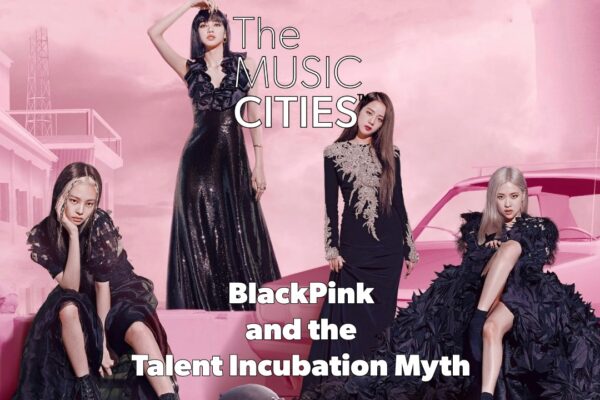
Episode Title: BLACKPINK and the Talent Incubation Myth
Episode Summary
BLACKPINK isn’t just a band — it’s the product of an economic system. In this episode, we break down how South Korea’s idol training model turned cultural output into a national export strategy and what that means for cities that are trying to build creative economies. It’s a story about scale, structure, and the limits of manufacturing authenticity.
Key Topics Discussed
South Korea’s Cultural Export Model
• How the K-Pop idol pipeline functions as a national strategy for economic growth and soft power.
• The intersection of government policy, corporate capital, and cultural production.
Talent Incubation as Economic Strategy
• How YG Entertainment and similar agencies operate as venture investors — recruiting thousands, training hundreds, launching a few.
• The economics of risk, failure, and the one-in-a-hundred success rate that produces global superstars like BLACKPINK.
Luxury Partnerships as Place Branding
• Why BLACKPINK’s ambassadorships for Dior, Chanel, and Celine function as national brand strategy for South Korea.
• How this approach redefines cultural diplomacy and “global cool.”
The Paradox of Manufactured Authenticity
• The K-Pop system can engineer skill, but not emotional connection.
• For every BLACKPINK, hundreds of perfectly trained groups fail to connect — proving that systems can’t replicate spontaneity.
BABYMETAL and the Organic Model
• How BABYMETAL’s “impossible” fusion of metal and J-Pop succeeded through authenticity and chaos.
• The contrast between engineered success and organic innovation as parallel paths to global impact.
Economic Development Lessons
• System design can create infrastructure, but not genius.
• Authenticity and emotional resonance can’t be programmed.
• Cities that want to compete globally must balance structure with freedom, policy with permission, and systems with soul.
• Real talent attraction starts with creating places where world-class creatives want to be, not where they’re told to go.
Why This Matters
Cities build incubators, creative hubs, and accelerators thinking they can “produce” innovation. South Korea proves that systems can scale talent — but connection, emotion, and authenticity are still the true differentiators. The same lesson applies to any city or region trying to grow its creative economy: design the framework, but leave room for lightning to strike.
Join the Tribe
Get early access to future episodes, exclusive case study reveals, and behind-the-scenes insights by joining our Patreon community at patreon.com/TheMusicCities.
Transcript
BLACKPINK and the Talent Incubation Myth
The Music Cities Podcast
Welcome back to The Music Cities. Today, we’re going to talk about a different path to global dominance in the music scene — one that came out of the most structured creative ecosystem on the planet.
We’re talking about BLACKPINK. For anyone unfamiliar, BLACKPINK is one of the most powerful cultural exports to ever come out of South Korea — maybe even all of Asia. They’re a global phenomenon with nearly a hundred million YouTube subscribers, massive world tours, and a fan base that crosses languages and continents.
They’re not just entertainers. They’re a case study in economic design.
The K-pop model is not four friends starting a band in a garage. It’s an entire national strategy for cultural export — a government-supported, industry-driven ecosystem that scouts thousands of recruits, trains hundreds of them, and launches a select few. These trainees learn everything: singing, dancing, choreography, languages, media relations, and even public diplomacy.
It’s cultural manufacturing at scale — and it works.
But that raises a question: what’s the cost of manufacturing culture? What’s lost when authenticity becomes a product line?
In previous episodes, we looked at how BABYMETAL flipped the script by taking a concept and turning it into an organic global movement. BLACKPINK represents the other side of that spectrum — the pinnacle of intentional, resource-intensive design.
The system that created them is deliberate, expensive, and risky. For every group that makes it, hundreds fail. But when it works, it’s extraordinary.
K-pop is South Korea’s soft power strategy — cultural output as economic development. It’s treated with the same strategic intensity as defense or technology. BLACKPINK sits at the top of that hierarchy — not just as musicians, but as brand ambassadors for Dior, Chanel, and Celine. That wasn’t an accident. Those brand deals were place-branding on a geopolitical scale.
Through BLACKPINK, South Korea communicates quality, modernity, luxury, and cool. It’s national identity as lifestyle marketing.
But even with that sophistication, there’s a paradox.
The K-pop system can manufacture perfection — but it can’t manufacture connection.
For every BLACKPINK, there are hundreds of equally polished groups that never connect with the public. The system can produce talent, but it can’t produce the spark — that lightning-in-a-bottle moment that makes people care.
It’s what I call manufactured authenticity. It looks real. It sounds real. But it doesn’t feel real.
BABYMETAL, by contrast, stumbled into authenticity through chaos. They started as an experiment that shouldn’t have worked — a fusion of idol pop and heavy metal. But as soon as they stepped on stage, the emotion was undeniable. They built a tribe.
This contrast gives us an important lesson in economic development.
Cities often make the same mistake as the entertainment industry. They believe that if they build the perfect incubator, the perfect plan, the perfect system, success will follow automatically. But systems don’t create connection. People do. Talent does.
You can’t spreadsheet your way to authenticity.
You can create the conditions, the infrastructure, the incentives — but the spark still comes from world-class talent choosing your place as the stage for their story.
That’s what made BLACKPINK special. Not the system itself, but the people inside it.
Rosé was raised in Australia. Lisa is from Thailand. Jennie was educated in New Zealand. Jisoo is the only homegrown Korean member. BLACKPINK isn’t just a Korean group; they’re an international supergroup that was built, refined, and branded in Korea.
That’s the lesson for cities. If you want to build an innovative, creative, global economy, you can’t just rely on your homegrown talent. You have to be a magnet for the best talent in the world.
The most successful cities — Silicon Valley, Miami, London, Seoul — all share the same characteristic. They attract talent first and build systems second.
Your city can have all the infrastructure in the world, but if the best people don’t want to be there, it doesn’t matter.
Economic development isn’t about buildings, districts, or incentives. It’s about talent — where it goes, why it stays, and how it connects.
That’s what BLACKPINK teaches us.
Korea built a system designed to mass-produce stars. It succeeded once because it found extraordinary talent — people who could transcend the structure that made them.
BABYMETAL succeeded because they trusted authenticity over design.
Both models work, but for completely different reasons. One is engineered for scale. The other thrives on chaos.
And that’s the bigger point: every remarkable success story — every band, startup, or city that changes the world — does it with an unfair advantage that can’t be replicated. Sometimes it’s a breakthrough idea. Sometimes it’s a small group of exceptional people.
But it’s never the system alone.
So as you think about your own city, your own business, or your own creative ecosystem, ask yourself: are you trying to build the factory, or are you building a place where lightning can strike?
Because in the end, authenticity wins.
The Music Cities is produced by BusinessFlare. For early access, behind-the-scenes insights, and full transcripts, join the tribe at patreon.com/TheMusicCities.